View Sidebar
Click on any book icon to see Table of Contents and/or to purchase a copy.

Articles by: Joan Wink

Prairie Pedagogy: Trailin Talks Trucks

Prairie Pedagogy: Trailin Talks Trucks

Dear WinkWorld Readers, 

If you have been following my blog, you are aware that one book project, “The Power of Story” is nearly finished, and I’ll soon be turning to the next writing project.  Since I have been collecting stories about the kids at Atall School, a one-room school in a very isolated part of the rural South Dakota, I’m hoping that some of these stories of teaching, learning, and loving make it into the next book.  As you know, these stories periodically appear in this blog, and have yet to be organized into a book proposal.

The first Prairie Pedagogy, I ever wrote can be found by clicking the link below. Thank you, South Dakota Magazine.

Prairie Pedagogy: A Day In Deep Creek School

In addition, more of my posts on prairie pedagogy can found found by clicking “Prairie Pedagogy” at the bottom of joanwink.com.

However, the purpose of this issue of WinkWorld, is to share the story of “Trailin Talks Trucks.”

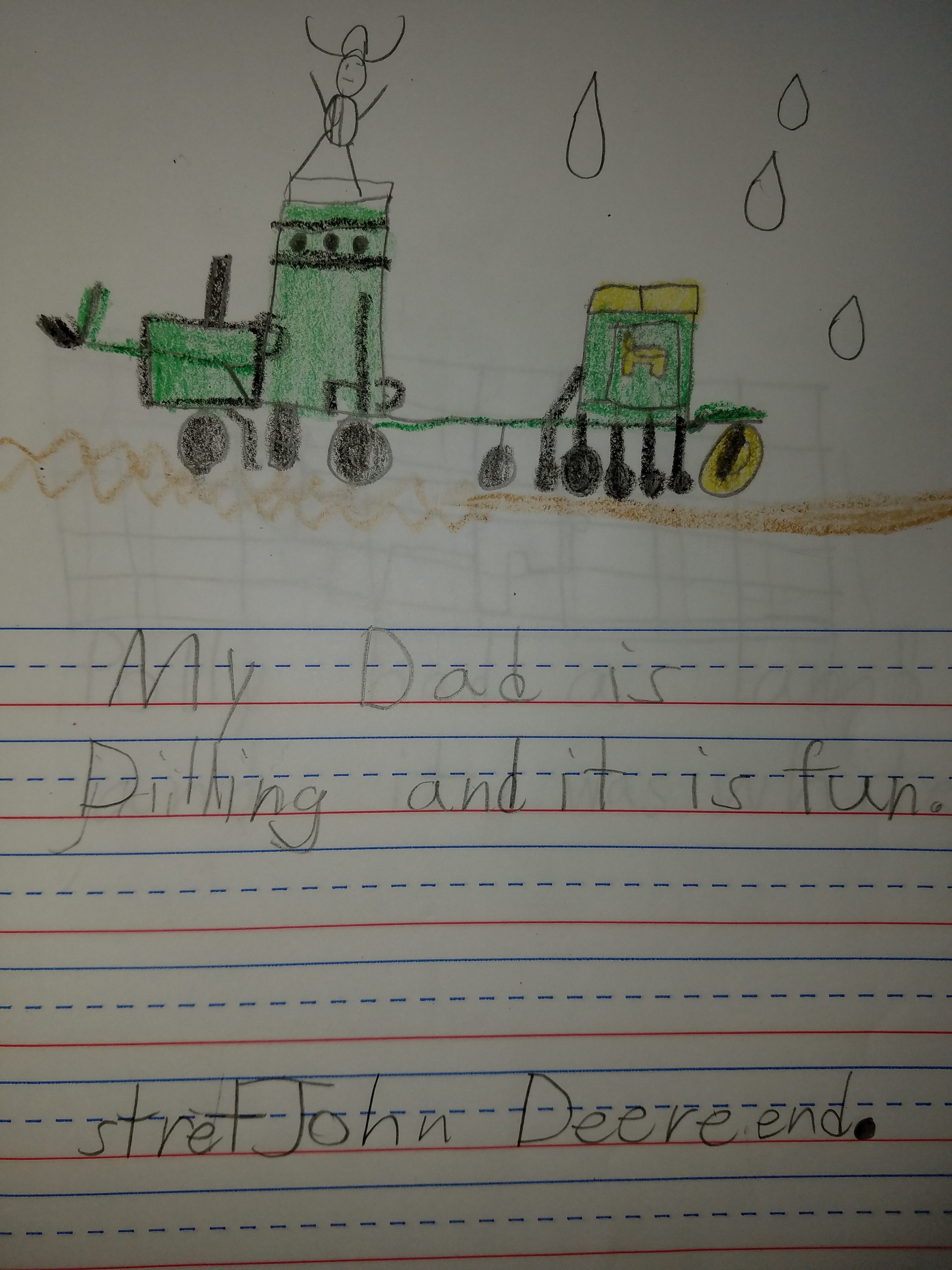
One of the things you will learn about Atall School students is that they are all authors–Yes. They all write and publish.  I first became aware of this when Trailin was in kindergarten, and I was walking by his desk and noted that several blank pieces of paper were stapled together, and the title page said in very large letters, MY JOURNAL.

A Primary Grade Writing Journal

I looked at each of the pages of inventive spelling with Trailin, and it was easy to read, as he wrote so well.
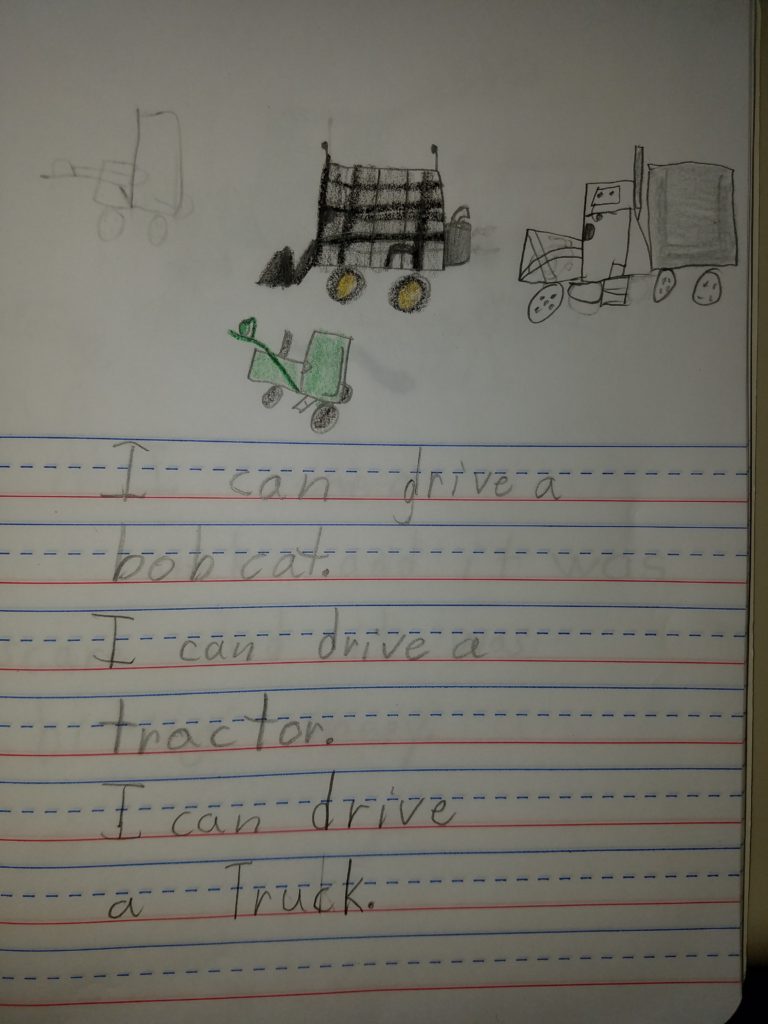
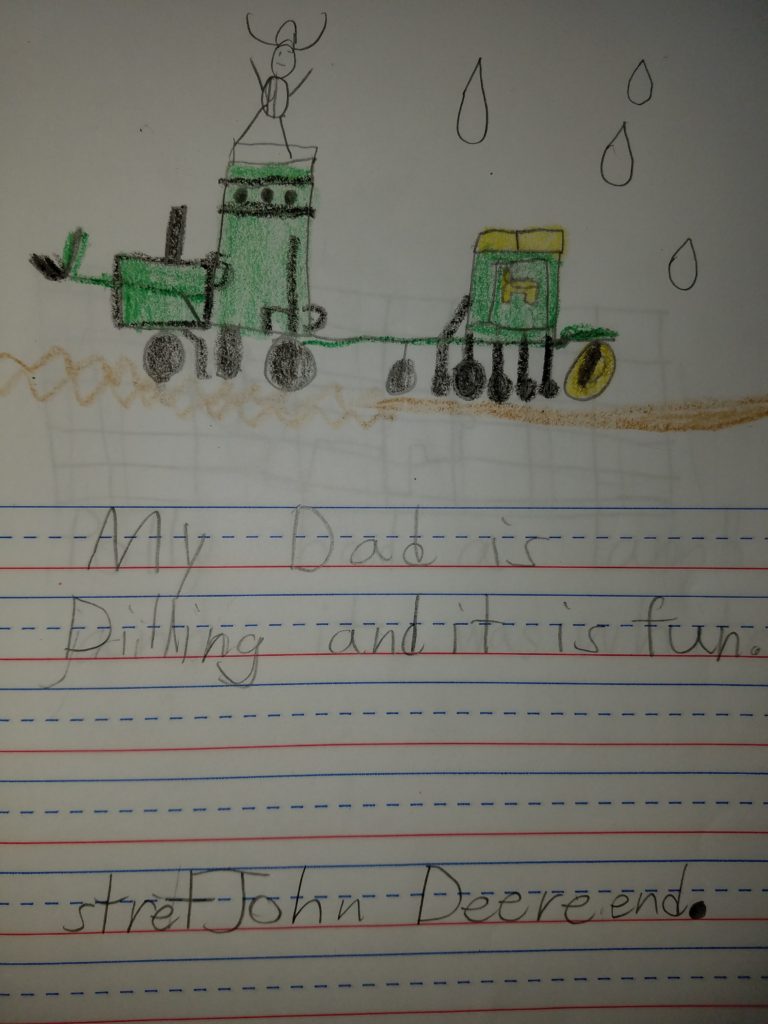
It became clear to me that each page was a story about a piece of equipment on his ranch. However, there was one page and one drawing, plus accompanying spelling me, which baffled me. So, I asked, “Trailin, can you please tell me about this page?” He looked at me as if I absolutely knew nothing because obviously, it was the “manure spreader” on his ranch.  And, as his oral pronunciation of the letter, r, had not yet fully developed, it made me smile to hear him say it.

Here is Trailin when he graduated from kindergarten.

Now, flash forward to Trailin as he completed grade two.

Back to the Books (a.k.a., Testing Therapy)

Recently, the students were in the middle of their days of mandated testing, and the teacher, Missy, wanted to have a post-test activity, which brought all of the kids together and affirmed them and their knowledge.

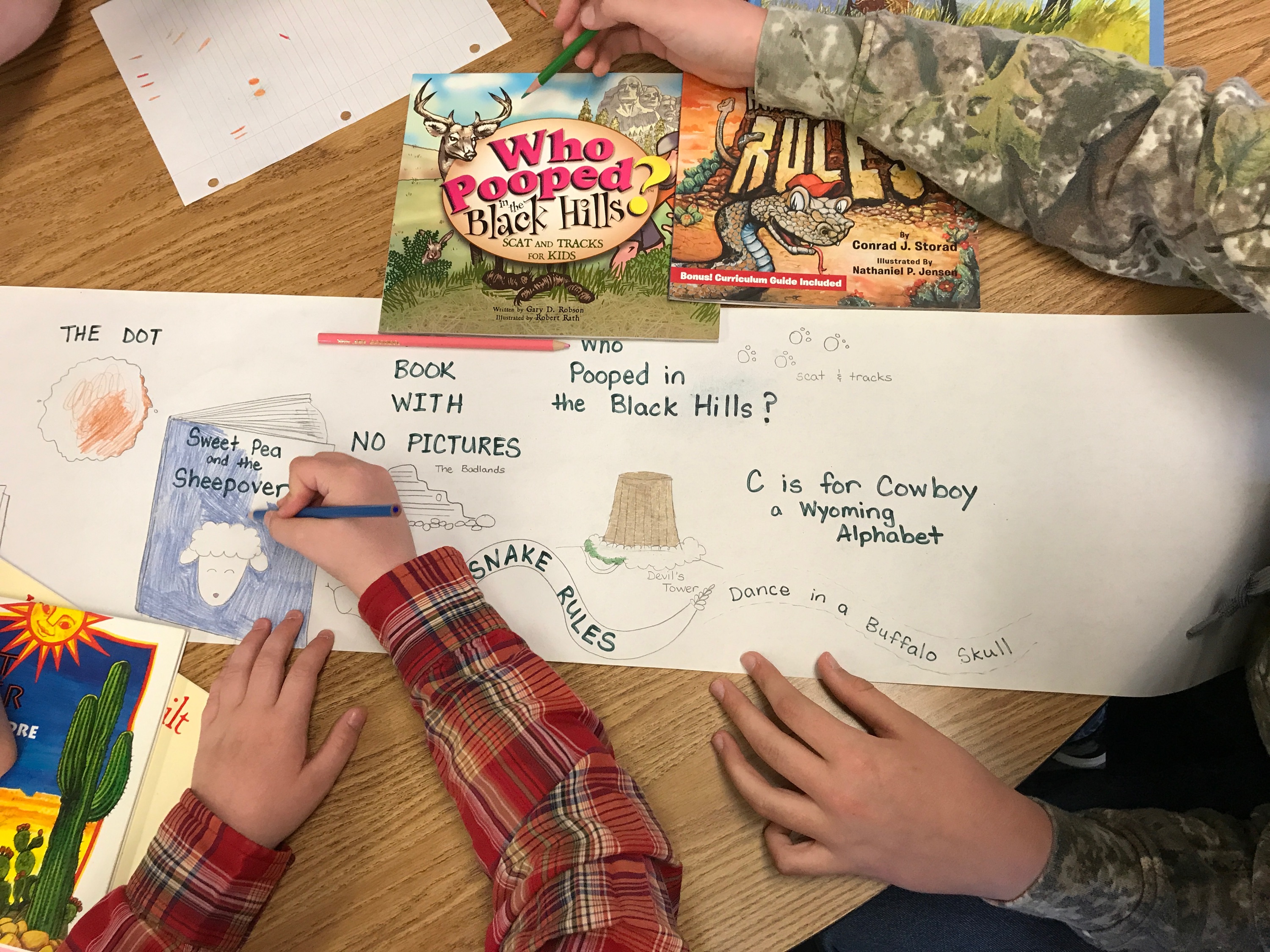
She brought out many of the books, which we had shared with the kids during the year. Next, she asked them to decorate a banner to celebrate their memories of their learning. Missy lead the discussion and highlighted language and ideas found in the various books. The kids had been discouraged and exhausted from the testing, but they soon began to come alive again, as they talked about the various books and what they remembered.
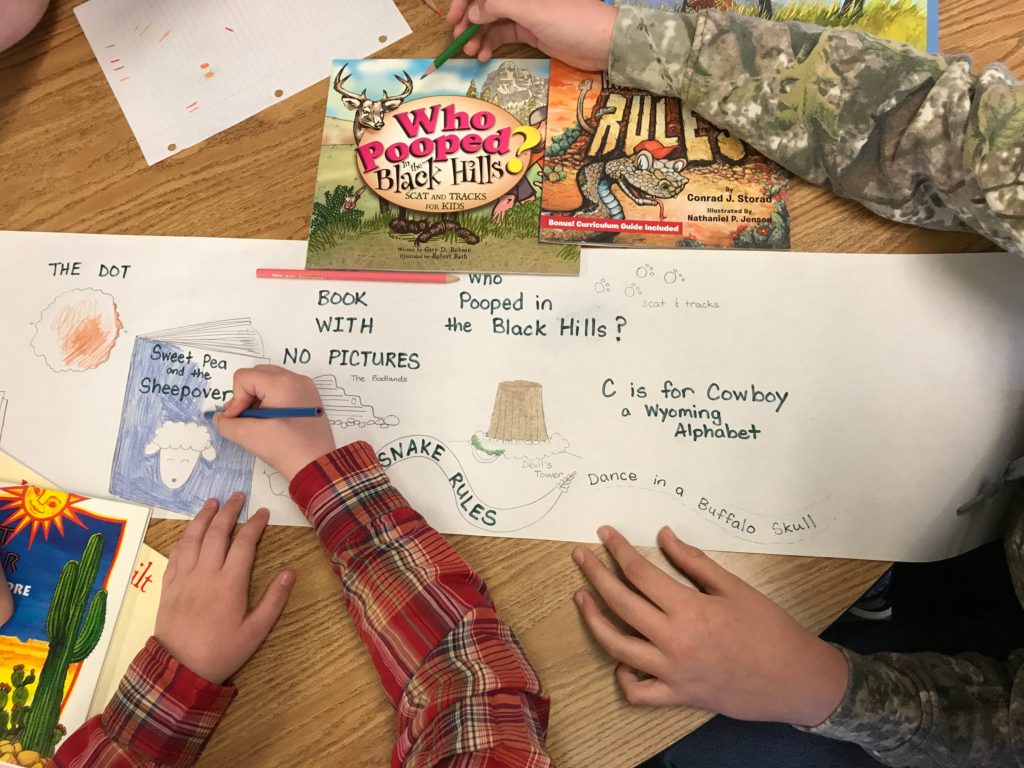
Next, each the students sat together at one table and chose a specific book to color on their school banner.

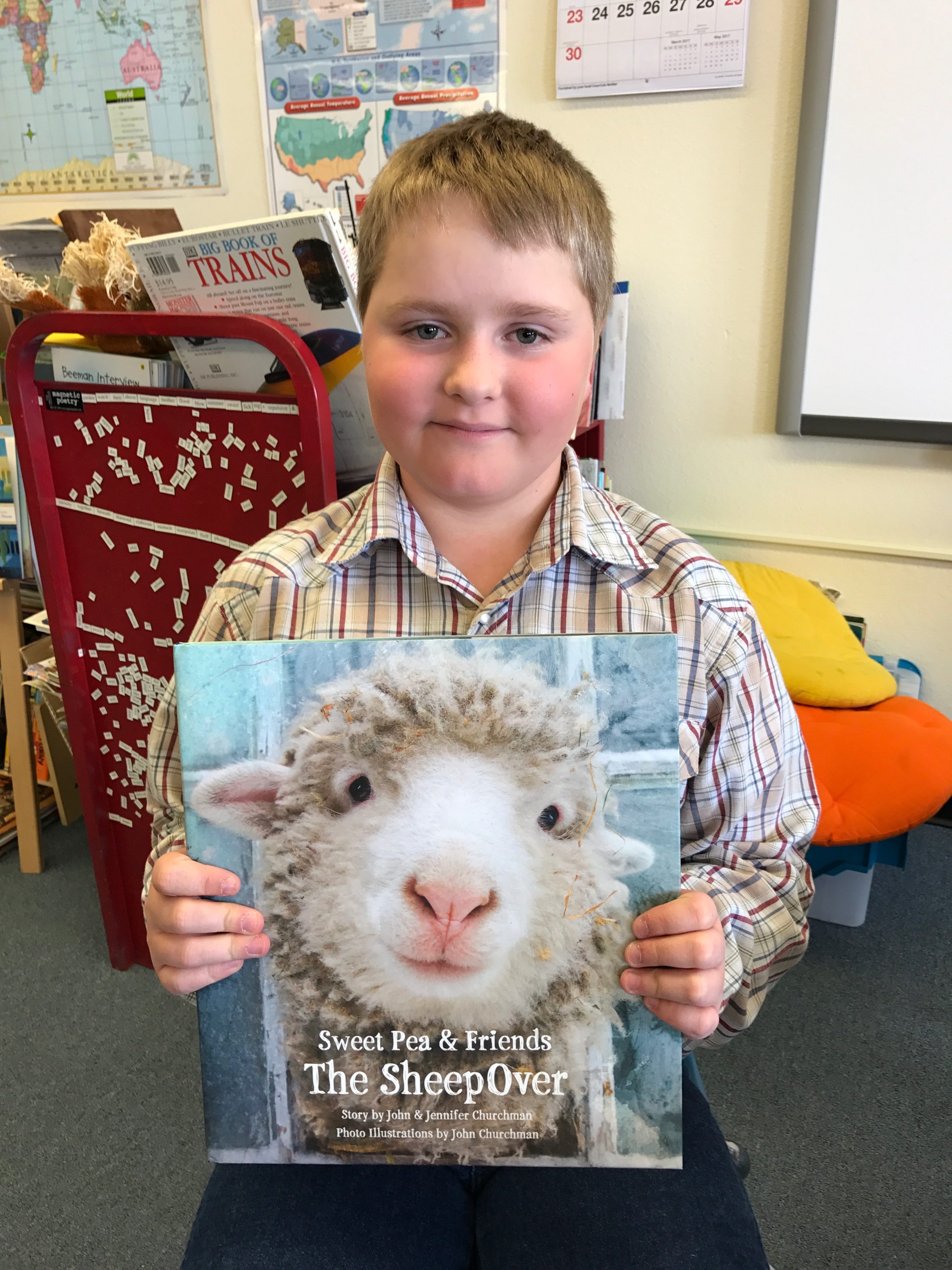
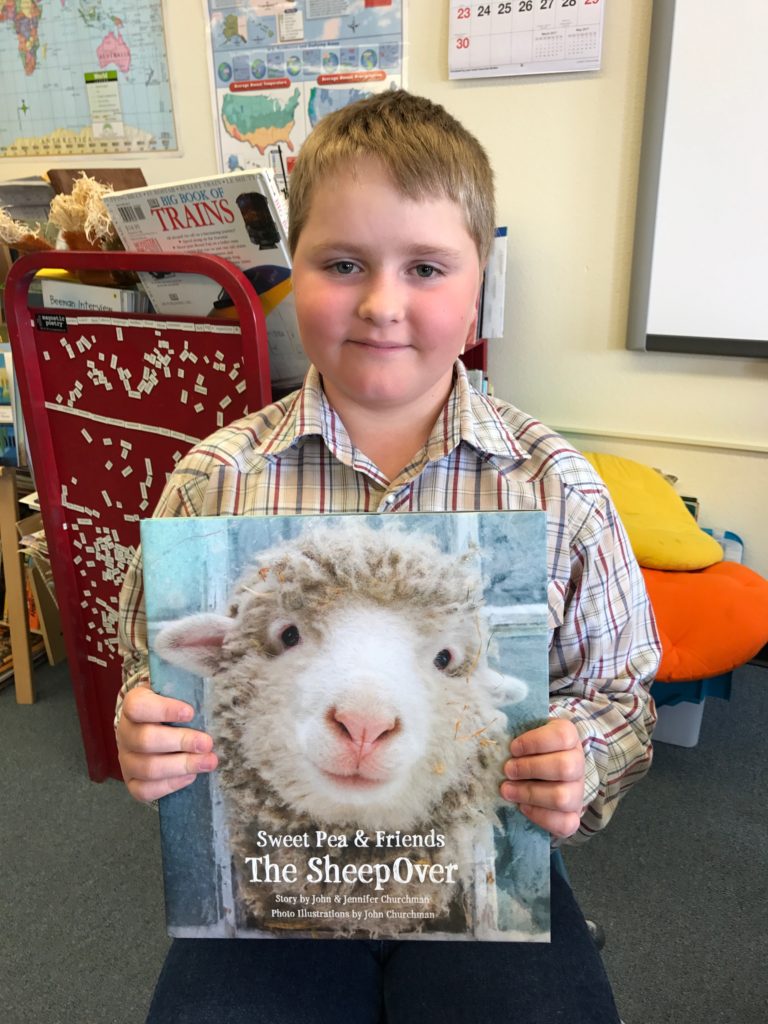
Trailin was adamant that he wanted to do the illustrations for Sweet Pea and Friends: The Sheepover,  a beautiful book by John and Jennifer Churchman.  I encourage you to check out their webpages. Click here.

Trailin loves this book, and so do I.
July 10, 2017Read More
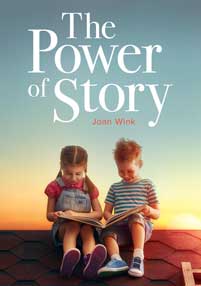
The Power of Story (my next book)

The Power of Story (my next book)

Hey WinkWorld Readers,

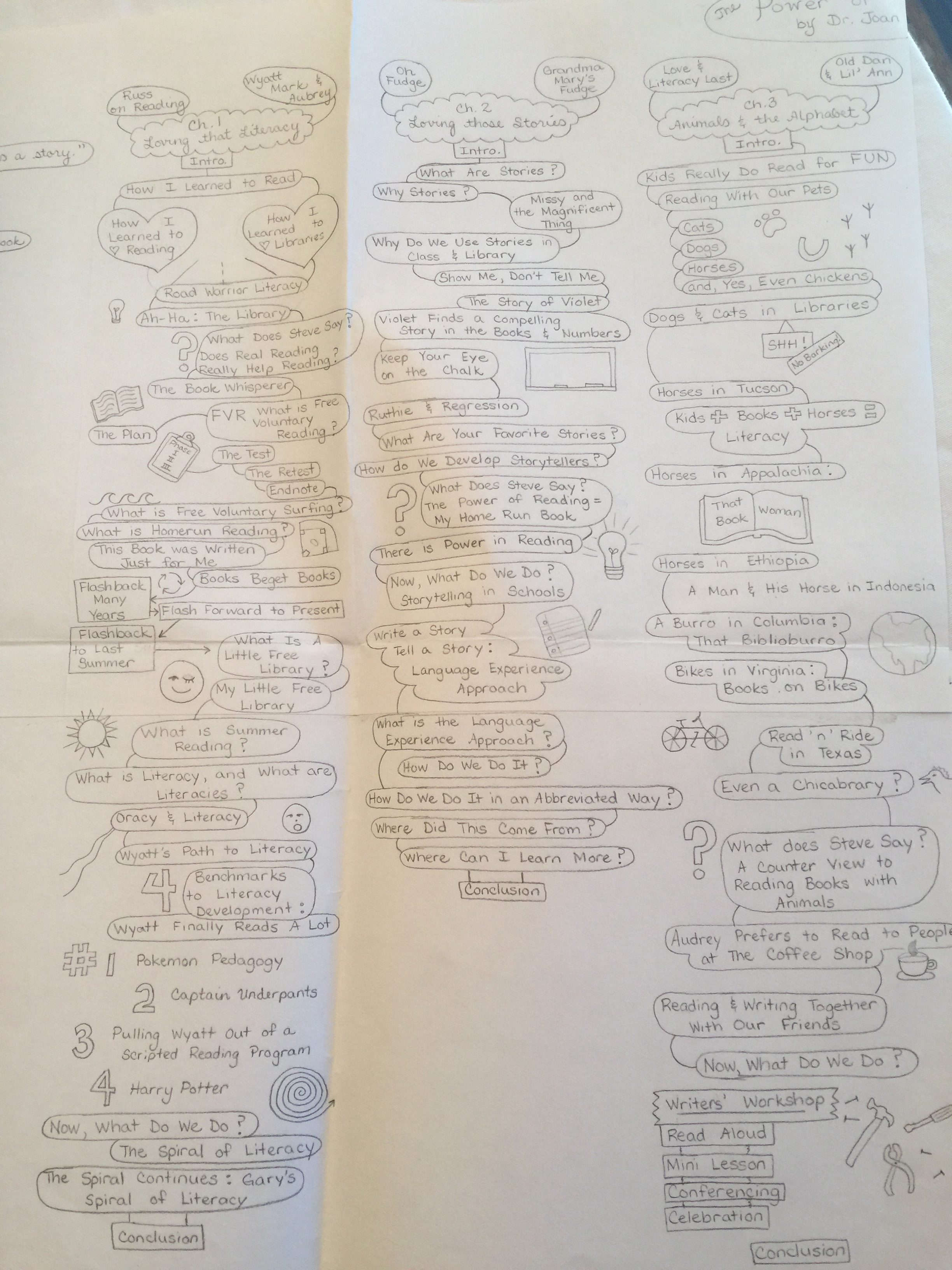
Look what I just found on my publisher’s webpages; I had not yet seen this cover.  The compositor and I still have a little work to do later this month. At that time I plan to share some visual chapter summaries, which Missy Urbaniak created for me.  Thanks, Missy.

#veryexcitedontheprairies

Just click on the title below to read about the book.

The Power of Story


July 2, 2017Read More
Prairie Pedagogy: Paul Interviews Missy

Prairie Pedagogy: Paul Interviews Missy

Dear WinkWorld Readers,

Meet the wonderful Atall School (K-8) of Meade County, South Dakota.  As some of you know, I have been reading and sharing books with this group of students for the past three or four years. I am loving the memories, which we are creating.  The truth: I am crazy in love with these kids, and I so appreciate the fact that the school community allows me to be a small part of the group.


(Atall School, fall 2016)

Recently, I introduced Missy Urbaniak, the teacher at Atall, to Dr. Paul Theobald, a leader in rural education in the US.  I first met Paul while we were both at TX A&M.  I was thrilled that Paul did an interview of Missy and published it with Rural School Collaborative, and I very much appreciate that Paul and this Collaborative agreed to share with us.

Before WinkWorld was a blog, it was a newsletter.  My previous posts (2002 – 2014) on  Prairie Pedagogy are still posted on my webpages.

Here is the most recent Rural Schools Collaborative

Click here to read the interview of Paul Theobald and Missy Urbaniak.


(Atall School, fall 2016)


May 10, 2017Read More
Personalized Learning = CBE: Ka-ching.

Personalized Learning = CBE: Ka-ching.


Dear WinkWorld Readers,

What in the world is personalized learning?  It sounds wonderful, doesn’t it? Be careful.  I have a hunch that it is called personalized learning to fool well-meaning people. I fear that it means one little person sitting in front of a computer (which the district has to buy), a program (which a district has to buy), and specific software (which  district has to buy), plus someone to “manage” the kids and computers.  

Ka-ching. Ka-ching. Ka-ching.

I fear the day will come when we just have managers, computers, and kids…  I far prefer my tax dollars be used to support a teacher, who actually knows the students and their needs and the wishes of the local community.

In what follows is a little overview of scholars, whom I respect, and their thoughts on personalized learning, which is also known as competency-based education.

“Testing All The Time? by McDermott, M., Robertson, P., and Krashen, S. (2016). Language Magazine, January.

Donalyn Miller on Twitter simply says:

“Personalized learning comes from kids, not programs.”
 
Alfie Kohn
 
eSchool News
 
Previously on WinkWorld, I wrote the following about my concerns.
 
Life long learning is not always fun…sometimes, the learning curve is steep and slippery.


April 26, 2017Read More
What is the ZPD? Or, How To Clean A White Board, or Mumbo Jumbo Theory

What is the ZPD? Or, How To Clean A White Board, or Mumbo Jumbo Theory


Dear WinkWorld Readers,

I was recently reminded of this story, which was published originally in “A Vision of Vygotsky,” a book which Le Putney and I wrote and published in 2002. I’ll post the complete citation at the end of this blog post.

Yes, in this article, you will learn a little about the Zone of Proximal Development (ZPD), a little about educational thought leaders, and a little about how to clean a white board, when it has been smeared with red permanent marker.  The ‘mumbo jumbo’ comment near the end of this story came from a student.  

Yes, this really did happen–you cannot make up stuff like this.

Happy Reading.

Mumbo Jumbo Theory

Wink, J., & Putney, L. G. (2002, pp. 104-107). A vision of Vygotsky. Boston, MA: Allyn & Bacon.


April 12, 2017Read More
Steven M. Singer: Kids are a captive market for the testing industry.

Steven M. Singer: Kids are a captive market for the testing industry.

Dear WinkWorld Readers, 

In the previous WinkWorld, I shared Nancy Bailey’s thoughts on what happens when librarians are replaced by computers. In what follows, I will share a recent blog from Steven M. Singer, where he demonstrates that the kids are really a captive market for the testing industry. I hope you will take time to read his entire post. 

Tomorrow, the 2 weeks of testing SmarterBalance  begins in SD.  I know some of these little SD captives, who have had a fabulous school year, and now after the practice tests, they feel like failures already.  For many, the teachers’ and students’ identity becomes defined by this one test.  It is heartbreaking.  I challenge any of you to take a practice test or two and share your scores with us.  

http://www.smarterbalanced.org/assessments/practice-and-training-tests/

Yes, you can sign in as a guest; you simply have to follow the prompts.  Try to image taking this test, as an 8-year-old and working on an unfamiliar computer….

Read below what Steven M. Singer has to say about this captive market.

https://gadflyonthewallblog.wordpress.com/2017/04/08/standardized-testing-creates-captive-markets/

More of Steven’s thoughts can be found at Gadflyonthewallblog.

My previous posts are always available WinkWorld News.

Older posts eventually roll over to the WinkWorld Archive found at the bottom of my main page.

April 11, 2017Read More
Nancy Bailey: Librarians or Computers?

Nancy Bailey: Librarians or Computers?

Dear WinkWorld Readers,

I rarely repost another’s blog, as there is already access for all.  However, recently, there have been two blogs (one from Nancy Bailey and another from Steven Singer), which I really want to highlight for you.

First, Nancy Bailey asks/answers the question: How are students hurt by replacing school librarians and libraries with computers?  

I hope you appreciate this blog post as much as I do.  You will notice that Steve Krashen jumped right in and said, “And there’s more!!! For many students, libraries are the only source of books for recreational reading, shown again and again to be the major source of literacy development.”  Thanks for always keeping us on our toes, Steve.

Please explore Nancy’s fabulous sharing  at  Nancy Bailey’s Education Website:  Revive, Rally, and Recover Public Schools.

Steven M. Singer is on deck next.

Thank you, Nancy and Steven and Steve.

My previous posts are always available WinkWorld News.

Older posts eventually roll over to the WinkWorld Archive  found at the bottom of my main page.

April 10, 2017Read More
Reading During the Testing Season

Reading During the Testing Season

Dear WinkWorld Readers,

This post is for all the teachers who are slogging through testing season.  Teachers, I know you know all that I am posting below, but sometimes it just helps to be reminded of what really works when it comes to reading and learning.  As you go through the pain of testing, maybe you and the students can some moments for healing and reading.

This list was compiled while I was listening to a group of teachers talk about, What Works With Reading.

Read

Be seen reading. Read to kids. Read with kids.

Make Available for Students the Best Selection of Books Possible

Use the library; use your friends and colleagues to have engaging, compelling, and comprehensible books. Create time for students to explore and choose books.

Exit Paper

Keep blank paper on students’ desk at all times. When class is dismissed, students hand you the paper, as they exit the room. Respond and return papers to students the next day.

Enjoy

Let students see your enjoyment of reading. Create time for students to enjoy reading.

Read Alouds

Read, read, read lots of stories to kids of all ages. Make time for students to talk about the stories.

Color. Color. Color.

Read books with beautiful illustrations.

Read-in

Bring in flashlights, pillows, treats and host a read-in.

Time and Variety

Allow time for reading: partner reading, coral reading, silent reading, oral reading.

Hug a Book

Hug a book in front of the students. Give the students a little background, and then ask, “Would you like to hear more tomorrow?”

Wordless Picture Books, Comics, and Graphic Novels

Create an extensive collection.

April 8, 2017Read More
Those People: You Know How They Are

Those People: You Know How They Are


Dear WinkWorld Readers,

Recently, while working on a project with CO colleagues, I came across this long-forgotten article buried deep in my computer, which was published 10 years ago.  For me, it seems relevant today also.

However, one caveat: Do NOT read this unless you read to the end of the article.  Another word of caution: The word, hate, is used in this article.  Yes, I could soften it, but honestly, these are the exact words, which the teachers (graduate students) used.  When you get to the “Mimi” story, those drawings are her family’s historical artifacts.  I was particularly honored that she shared these primary sources with us.  It was extremely painful for her to relive that part of her life.  

I remember this experience, as one of the most powerful classroom experiences I ever had.  Thank you again to those who contributed.

Those People WinkWorld 3.29.2017


March 30, 2017Read More
Pre-K Babes Who Speak Other Languages at Home: What do we do?

Pre-K Babes Who Speak Other Languages at Home: What do we do?

Dear WinkWorld Readers, 

A colleague in Colorado invited me to work with her during an online inservice in late March. The participants are Pre-K professionals: leaders and service-providers. The Pre-K babes in their classes tend to come from homes, where other languages are used. Spanish is the target language for many, but increasingly immigrant and refugee children are in their classes.  She and I are generating some ideas, so I decided to share in WinkWorld in case anyone else needs this content or wants to share their ideas with us.

“Storytelling is not something we do. Storytelling who we are.”

~Carmine Gallo, 2016, p. xvii

Our goal: Active engagement with families and their children’s emergent literacy.

Our focus: Oral language is a path to literacy, and stories provide oral language. What matters most for developing literacy is lots and lots of good oral language found in storytelling and reading books to kids.

Word clouds, (Wordle, Cloud Sift, Tagxedo)

The following word clouds were created by Susan Henley Spreitzer. Thank you.

What are stories?

Why Stories?


Focus questions:

How do we get families through the door? Once they are through the door, what do we do?

Resource to be used for this discussion: Models of Parental Involvement, or “Do it to ’em, or do it with ’em.”

James Cummins’s Model of Literacy Engagement

For more resources on this topic for use in CO, visit Joan’s Schedule, March 28, 2017.

http://www.joanwink.com/joans-schedule/


February 18, 2017Read More